Overview
It is believed by some that hell, rather than being "a painful
retribution in the afterlife" characterized by "excruciating torments,"
is instead representative of a state of nonexistence. "The Bible hell,
then, is the common grave of mankind where good people as well as bad
ones go." Moreover, because the soul of a person completely defines the
person, the soul dies when the person dies, and the individual "no longer
presently exists (sic) in any form." Such a fate is not entirely without
hope however since "Although no longer presently existing in any form,
millions of dead ones who are in Jehovah God’s memory will be resurrected,
or brought back to life, in a restored earthly paradise." In light of
this, one’s life should be devoted to pleasing Jehovah God by obeying
His law and ways. A life so lived would be memorable to God and thereby
entitle the individual to resurrection in the new kingdom.
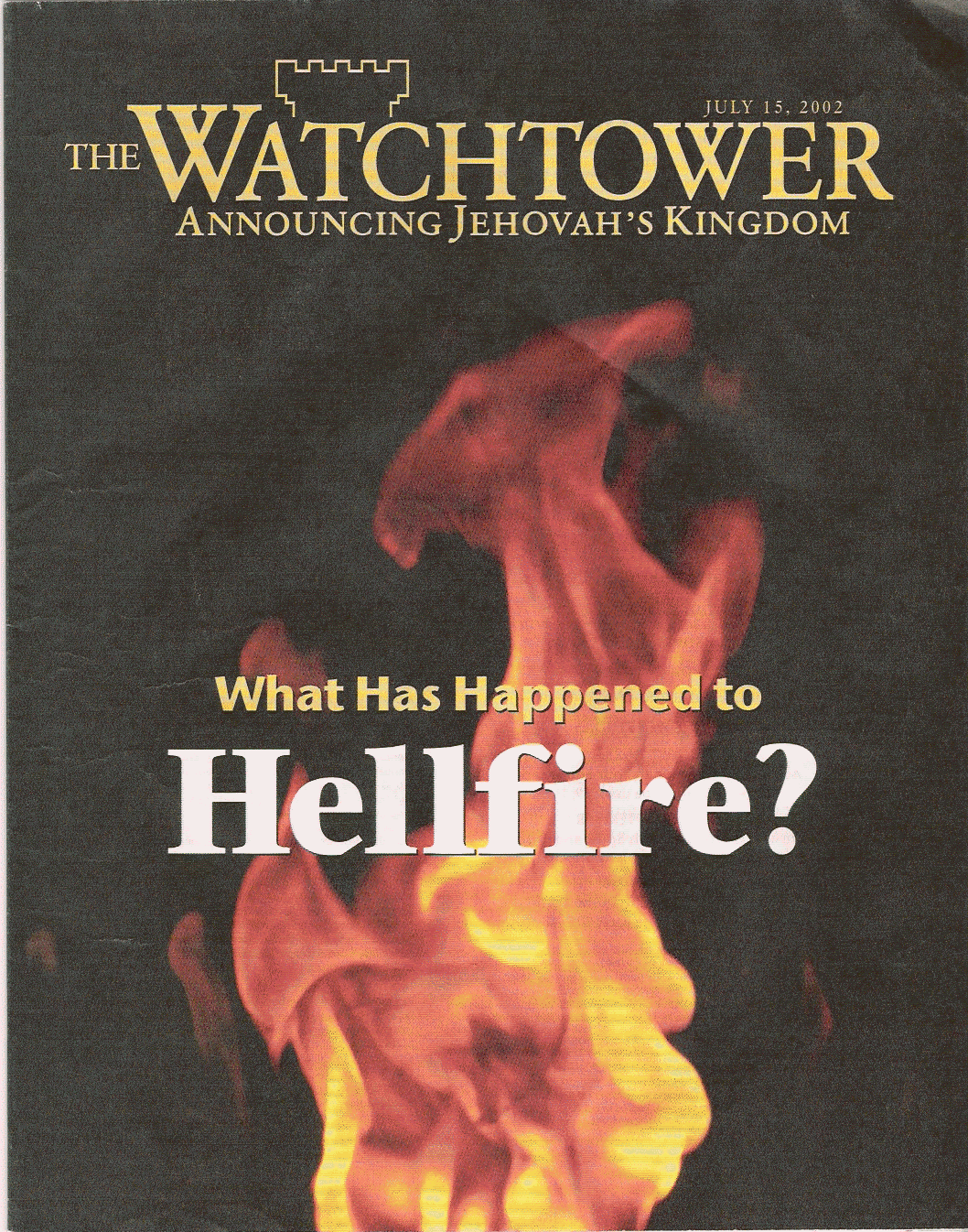
[Watchtower, Jehovah’s Witnesses, Title, Date.]
Is such a view consistent with the scriptures of the Bible?
Analysis
The Bible contains many verses pertinent to hell and the question of an afterlife. In short, the Bible depicts a conscious existence following one’s physical death with this existence characterized by either blessed rest in the presence of God in heaven or restless torment in a palpable unquenchable fire in hell. To make this point clear, a detailed examination of the scriptures is now given.
The Bible is very clear that one’s life continues in a conscious state after the physical body ceases to live. In other words, the soul lives even after the body dies. Consider Jesus' words:
"Do not be afraid of those who kill the body but cannot kill the soul. Rather, be afraid of the One who can destroy both soul and body in hell."
This distinction by Jesus between the death of the body and the death of the soul is echoed again in Luke 12:5. Jesus indicates here that the death of the body is separate from and less important than the death of the soul. We are all familiar with physical death. In light of Jesus' words, it is of greater importance that we understand the deadl. the soul.
Additional proof from scripture about life after death is provided by the apostle Peter and the apostle Paul who both refer to their physical, earthly body as a "tent" which is laid aside at death and is to be replaced by an eternal spiritual body at the resurrection (see II Pet. 1:13-14). Consider the following passages:
"Now we know that if the earthly tent we live in is destroyed, we have a building from God, an eternal house in heaven, not built by human hands."
For while we are in this tent, we groan and are burdened, because we do not wish to be unclothed but to be clothed with our heavenly dwelling, so that what is mortal may be swallowed up by life."
Biblical evidence of man’s creation as body, soul and spirit, each of which is distinct, is further referred to in the following verses:
"May God himself, the God of peace, sanctify you through and through. May your whole spirit, soul and body be kept blameless at the coming of our Lord Jesus Christ."
"For the word of God is living and active. Sharper than any double-edged sword, it penetrates even to dividing soul and spirit, joints and marrow; it judges the thoughts and attitudes of the heart."
Jesus provides more insight into paradise and the consciousness of living souls in the afterlife in the parable of the rich man and Lazarus:
There was a rich man who was dressed in purple and fine linen and lived in luxury every day. At his gate was laid a beggar named Lazarus, covered with sores and longing to eat what fell from the rich man’s table. Even the dogs came and licked his sores. The time came when the beggar died and the angels carried him to Abraham’s side. The rich man also died and was buried. In hell, where he was in torment, he looked up and saw Abraham far away, with Lazarus by his side. So he called to him, "Father Abraham, have pity on me and send Lazarus to dip the tip of his finger in water and cool my tongue, because I am in agony in this fire." But Abraham replied "Son, remember that in your lifetime you received your good things, while Lazarus received bad things, but now he is comforted here and you are in agony. And besides all this, between us and you a great chasm has been fixed, so that those who want to go from here to you cannot, nor can anyone cross over from there to us." He answered "Then I beg you, father, send Lazarus to my father’s house, for I have five brothers. Let him warn them, so that they will not also come to this place oftorment."
This parable suggests that the souls of those who die physically continue to live and that they are aware of their former life on earth, their former relationships, their current environment, their pain or pleasure and the passage of time. Paul addresses this theme in his letters by expressing his desire to leave his earthly life to be immediately joined with Jesus Christ in the next.
For to me, to live is Christ and to die is gain. If I am to go on living in the body, this will mean fruitful labor for me. Yet what shall I choose? I do not know! I am tom between the two: I desire to depart and be with Christ, which is better by far; but it is more necessary for you that I remain in the body.
Therefore we are always confident and know that as long as we are at home in the body we are away from the Lord. We live by faith, not by sight. We are confident, I say, and would prefer to be away from the body and at home with the Lord.
Another example is provided by the activities of living souls in heaven whose bodies were killed on earth during the end days:
When he opened the fifth seal, I saw under the altar the souls of those who had been slain because of the word of God and the testimony they had maintained. They called out in a loud voice "How long, Sovereign Lord, holy and true, until you judge the inhabitants of the earth and avenge our blood?"
Here again is proof that souls of people live on after their physical death, that they are aware and active in the afterlife and aware of the passage of time and of events occurring on earth.
The Bible does not stop at merely describing souls as living after the death of the body and of being fully aware of their surroundings in the afterlife. Rather, it goes on to describe in some detail the surroundings into which these conscious living souls are given to spend all of eternity. The preceding passage from the book of Revelation indicates that souls of the martyred righteous reside in God’s presence in heaven. Conversely, several scriptures indicate that the souls of the unrighteous currently are confined to hell which will later be assimilated into the Lake of Fire. The following passages provide some description of hell, its occupants and its future:
Then he will say to those on his left, "Depart from me, you who are cursed, into the eternal fire prepared for the devil and his angels."
For if God did not spare angels when they sinned, but sent them to hell, putting them into gloomy dungeons to be held for judgment;
And if your eye causes you to sin, pluck it out. It is better for you to enter the kingdom of God with one eye than to have two eyes and be thrown into hell, where their worm does not die, and the fire is not quenched.
— (See also Isa. 66:24)
A third angel followed them and said in a loud voice: "If anyone worships the beast and his image and receives his mark on his forehead or on the hand, he, too, will drink of the wine of God’s fury, which has been poured full strength into the cup of his wrath. He will be tormented with burning sulfur in the presence of the holy angels and of the Lamb. And the smoke of their torment rises forever and ever. There is no rest day or night for those who worship the beast and his image, or for anyone who receives the mark of his name."
But the beast was captured, and with him the false prophet who had performed the miraculous signs on his behalf. With these signs he had deluded those who had received the mark of the beast and worshiped his image. The two of them were thrown alive into the fiery lake of burning sulfur.
And the devil, who deceived them, was thrown into the lake of burning sulfur, where the beast and the false prophet had been thrown. They will be tormented day and night for ever and ever.
Then death and Hades were thrown into the lake of fire. The lake of fire is the second death. If anyone’s name was not found in the book of life, he was thrown into the lake of fire.
These verses reveal a literal place called hell, which was created as a place of punishment for the devil and his angels. It is a place of eternal torment and umest involving unquenchable fire. That human souls are conscious and in torment is evidenced by the activities of weeping and gnashing of teeth which stands in stark contrast to the blessed activities of conscious living human souls in heaven where God Himself wipes away all tears for ever.
Consider how the meaning of the following verses are distorted by substituting the the grave for hell:
For if God did not spare angels when they sinned, but sent them to hell (the grave?), putting them into gloomy dungeons to be held for judgment;
The tongue also is a fire, a world of evil among the parts of the body. It corrupts the whole person, sets the whole course of his life on fire, and is itself set on fire by hell (the grave?).
Hell is a literal place oftorment for conscious living human souls inasmuch as heaven is a place of rest and reward in God’s presence for righteous human souls. Because all scripture is in harmony with the truth, what then is the meaning of verses which appear to indicate that man is no different than the animals; that his body returns to dust and his soul likewise perishes just as the animals'? For example, how are the scriptures presented above in harmony with the following:
Man’s fate is like that of the animals; the same fate awaits them both: As one dies, so dies the other. All have the same breath; man has no advantage over the animal. Everything is meaningless. All go to the same place; all come from the dust, and to dust all return.
For the living know that they will die, but the dead know nothing; they have no further reward, and even the memory of them is forgotten.
The answer to this apparent contradiction is found by considering the context of the text. Ecclesiastes is written from the perspective of the earthly life that in the grand scheme of eternity is vanity and striving after the wind. To see this, consider the following:
All share a common destiny - the righteous and the wicked, the good and the bad, the clean and the unclean, those who offer sacrifices and those who do not. As it is with the good man, so with the sinner; as it is with those who take oaths, so with those who are afraid to take them. This is the evil in everything that happens under the sun: The same destiny overtakes all. The hearts of men, moreover, are full of evil and there is madness in their hearts while they live, and afterward they join the dead.
We know from Jesus' words in Matt. 25 that the destiny of the wicked is markedly different from that of the righteous. However, when viewed from this life alone, man is no different from the animals as regards mortality. All die regardless of how they lived their lives. In this regard, all men share the same destiny as all other animals with that destiny being physical death. However, the view that this life is all there is and that it amounts to nothing in the grand scheme of eternity is totally contrary to the view that the righteous are to hold which is described by Paul as follows:
Whatever you do, work at it with all your heart, as working for the Lord, not for men, since you know that you will receive an inheritance from the Lord as a reward. It is the Lord Christ you are serving. ….. If the dead are not raised, "Let us eat and drink, for tomorrow we die."
(comp. Eccl. 2:24,3:12-13,5:18,8:15)
Therefore we do not lose heart. Though outwardly we are wasting away, yet inwardly we are being renewed day by day. For our light and momentary troubles are achieving for us an eternal glory that far outweighs them all. So we fix our eyes not on what is seen, but on what is unseen. For what is seen is temporary, but what is unseen is eternal.
Brothers, we do not want you to be ignorant about those who fall asleep, or to grieve like the rest of men, who have no hope. We believe that Jesus died and rose again and so we believe that God will bring with Jesus those who have fallen asleep in him.
So we make it our goal to please him, whether we are at home in the body or away from it. For we must all appear before the judgment seat of Christ, that each one may receive what is due him for the things done while in the body, whether good or bad.
To base ones view of hell and the afterlife on a set of verses found within the context of an earthly perspective of life is to totally miss the true reality of a literal hell. This distorts the meaning of numerous scriptures. More importantly, it jeopardizes the eternal soul of one who cannot take seriously warnings meant to prevent him from incurring damnation he does not believe to even exist.
Clearly, man is an eternal being whose earthly body perishes but whose soul continues in a conscious state for all of eternity. Man continues to feel, to think, to engage in activity in either heaven or hell. The death (or destruction) of the soul Jesus referred to in Matt. 10:28 is the second death of Rev. 20:14 and 21:8 which involves an eternity of conscious existence in a literal inferno originally created to punish the devil and his angels. We can share the blessings of heaven with Christ by accepting him as our only Lord and Savior, or we can share in the punishment of the devil and his angels in hell as paYment for our own sin.
For the wages of sin is death, but the gift of God is eternal life in Christ Jesus our Lord.
For it is by grace you have been saved, through faith-and this not from yourselves, it is the gift of God- not by works, so that no one can boast."